

Iceland solo travel is one of the most rewarding adventures on Earth a journey through volcanic fire, ancient glaciers, and midnight sun that you carry alone but never feel lonely doing.
There is a moment on the road in Iceland somewhere between a steaming lava field and a glacier that stretches to the horizon when you realize this place was designed for people drawn to Iceland solo travel. Iceland solo travel is not just a trip. It is a full psychological reset. During Iceland solo travel, you drive when you want, stop when something moves you, and shape each day around your own curiosity, and spend an entire golden evening standing under a waterfall with no one waiting on you. That kind of freedom is rare, and Iceland delivers it more completely than almost any destination on Earth.
This reputation is backed by data: the country has held the number one spot on the Global Peace Index for 17 consecutive years. That ranking is not just a statistic — it is a lived reality that solo travelers feel within hours of landing. Police here do not carry firearms. Crime is so rare that locals routinely leave cars unlocked and café owners do not watch their bags. For a solo traveler arriving in Reykjavík for the first time, this social atmosphere is immediately noticeable and deeply reassuring.
Iceland solo travel also benefits from something practical: nearly everyone speaks English. You do not need Icelandic to navigate, book tours, ask for help, or decode road signs. The entire tourism infrastructure — from guesthouses to guided glacier hikes — is built around individual travelers joining experiences on their own. This removes a layer of anxiety that accompanies Iceland solo travel in countries with language barriers or closed social norms.
The landscapes themselves are what makes Iceland solo travel the engine of every experience here. One of the core joys of Iceland solo travel is the variety: in a single day you can walk across lava formed last year, climb onto a glacier that has been moving for ten thousand years, and soak in a geothermal pool while steam rises around you. Every part of this is accessible without a tour group, without a travel partner, and without a complicated logistics chain. Rent a car, load a map, and Iceland solo travel opens up entirely.
Understanding Iceland’s Volcanoes Before You Go
Iceland sits directly on the Mid-Atlantic Ridge, the boundary where the North American and Eurasian tectonic plates drift apart. This geological reality means the island is one of the most volcanically active places on Earth, and understanding that before you arrive is essential for every Iceland solo travel plan.
The Reykjanes Peninsula has experienced recurring volcanic eruptions since 2021, with the most recent significant activity at the Sundhnúkagígaröðin crater row occurring through 2024 and 2025. These eruptions are classified as “effusive,” meaning they produce slow-moving lava flows rather than ash clouds. This is why Keflavík International Airport — which sits on the same peninsula — has remained fully operational throughout every eruption since 2021. Unlike the 2010 Eyjafjallajökull event that shut down European airspace for weeks, current volcanic activity does not threaten flight operations.
What it can affect during Iceland solo travel is localized access. The Blue Lagoon geothermal spa has been evacuated during eruption events. Parts of Grindavík town have been placed under exclusion zones. These disruptions matter for Iceland solo travel planning but are highly contained — they affect a small geographic area while leaving the rest of Iceland, including all Golden Circle attractions, South Coast waterfalls, and glacier tours, completely unaffected.
The practical steps for managing volcanic risk during Iceland solo travel are straightforward:
- Check SafeTravel.is before every day of activity
- Monitor the Icelandic Meteorological Office for volcanic gas and air quality alerts
- Respect all exclusion zones — they change with lava direction and gas concentration
- Purchase travel insurance that explicitly covers volcanic disruption and evacuation
One additional concern that visitors underestimate is volcanic gas. Eruptions release sulfur dioxide, which can reach dangerous concentrations far from the actual lava. Wind can carry these gases into Reykjavík itself. Travelers with respiratory conditions should check air quality readings daily. The government of Iceland publishes live air quality data, and understanding how to read those readings before you need them is a sensible part of any solo trip preparation.
Glaciers: Iceland’s Frozen Giants and How to Approach Them Safely
Glaciers are among the defining physical challenges and rewards of Iceland solo travel, covering approximately ten percent of the country’s total land area. The largest of them, Vatnajökull, is the biggest ice cap in Europe — a slow-moving frozen continent that conceals active volcanoes beneath its surface and produces rivers so powerful they reshape valleys over decades. For anyone on an Iceland solo travel journey, glacier access is both a highlight and a category of risk that deserves serious attention.
The most important rule in Iceland solo travel on glaciers is absolute: never walk on a glacier without a certified guide, proper equipment, and crampons. This is not cautious tourist advice — it is the hard lesson of a long history of accidents. Glaciers contain crevasses that are invisible from the surface, zones of blue ice that offer no grip, and meltwater channels that appear stable until they are not. What looks like solid ground can be a snow bridge over a drop of thirty meters.
The most accessible glacier hike for those doing Iceland solo travel is Sólheimajökull on the South Coast, where certified operators run small-group crampons hikes daily. Joining one of these during Iceland solo travel is easy — the groups are small, the guides are expert, and the ice itself is extraordinary. You walk across an ancient surface marked by ash layers from past eruptions, past towers of blue ice and around the edges of crevasses wide enough to swallow a car. It takes approximately three hours and requires no prior experience.
Vatnajökull offers a different scale entirely. Tours departing from Skaftafell and Jökulsárlón take you deeper into the ice, including into natural ice caves during winter months. The Katla Ice Cave — accessed through Mýrdalsjökull glacier above the Katla volcano — is another experience entirely: dark volcanic ash streaked through blue ice, the result of eruptions that happened centuries ago and are now frozen into geological memory.
The jökulhlaup is a glacial hazard that every Iceland solo travel itinerary should account for — a glacial lake outburst flood triggered when volcanic heat beneath a glacier melts ice rapidly. These floods are unpredictable, can last from hours to weeks, and are powerful enough to sweep away bridges and close sections of the Ring Road. Checking road status at Road.is before every day of driving is not optional; it is standard practice for Iceland solo travel done independently.
Planning Your Iceland Solo Travel Itinerary: Season by Season
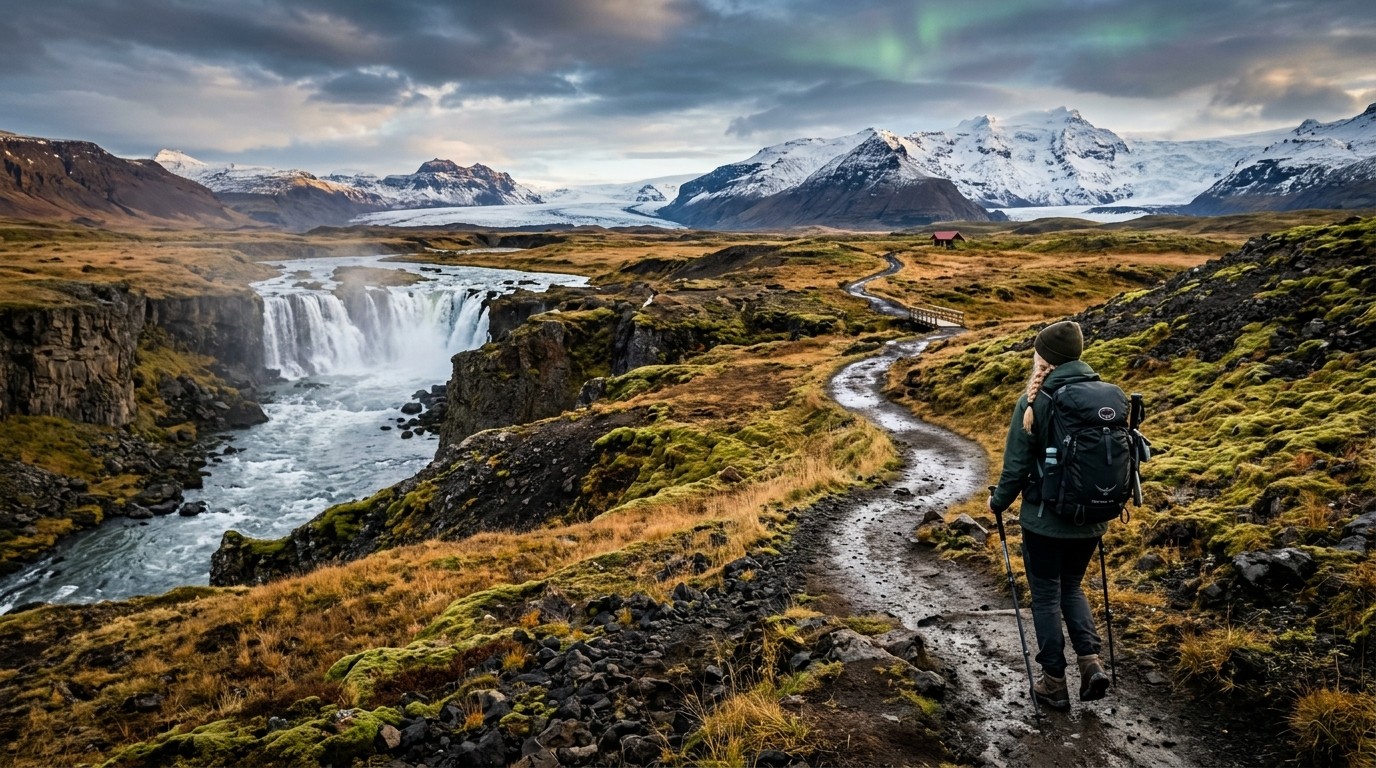
Timing changes almost everything about Iceland solo travel — the light, the roads, the activities available, the crowds, and the psychological tone of the experience.
Summer (June–August): The Midnight Sun Season
This is the most forgiving season for first-time solo travelers. Days stretch to twenty-four hours of usable light, road conditions are at their best, and the full range of tours and activities is available. The Ring Road is entirely passable for standard rental cars, and even many interior highland roads open during this period.
The trade-off is cost and crowds. Summer is Iceland’s peak season, and accommodation prices rise significantly, particularly in Reykjavík and along the South Coast. Popular spots like Skógafoss waterfall and Reynisfjara black sand beach fill quickly. If you plan summer Iceland solo travel, book accommodation three to five months in advance, especially for anything along the South Coast between Vík and Jökulsárlón.
One extraordinary addition for summer 2026: a total solar eclipse will be visible from Iceland on August 12. If your travel dates have any flexibility, this is a once-in-a-generation opportunity.
Autumn (September–October)
Autumn is a strong choice for experienced travelers doing Iceland solo travel. Crowds thin noticeably, prices drop from summer peaks, and the northern lights begin appearing by late September. Icelandic highland roads start closing in October as snow arrives. Waterfall flow tends to be high after summer rains, and the landscape takes on colors — orange moss, rust-brown lava fields — that summer does not offer.
Winter (November–March)
Winter Iceland solo travel is not for first-timers driving independently. Days are short — sometimes as few as four to five hours of usable light — roads can become impassable without significant experience driving on ice, and many highland routes close entirely. What winter does offer is extraordinary: the northern lights at full intensity, natural ice caves accessible inside glaciers (they are only safe when temperatures are cold enough for the ice to stabilize), and a quieter, more raw version of Iceland that summer never shows.
Spring (April–May)
Spring is often underrated. Highland roads begin reopening, prices remain below summer levels, and the landscape is in transition — snow still on the mountains, but green moss beginning to emerge below. Spring Iceland solo travel rewards travelers who want shoulder-season pricing with improving road access.
The Ring Road: A Solo Traveler’s Best Framework
Route 1, the Ring Road, circles Iceland’s entire coastline for approximately 1,332 kilometers. Driving the Ring Road is one of the most popular frameworks for Iceland solo travel, and for good reason: it gives you access to nearly every major natural attraction without requiring you to plan complicated logistics.
A standard 2WD rental car is sufficient for the full Ring Road in summer. Costs for a basic vehicle with insurance typically run between $100 and $160 per day. From January 2026, Iceland replaced fuel duties with a per-kilometer road tax, so fuel prices at the pump dropped but a road charge now applies — most rental companies handle this as a flat daily rate or odometer-based charge at return.
| Trip Length | Best For | Route Coverage |
|---|---|---|
| 5 days | First-timers | Reykjavík + South Coast |
| 7 days | Moderate experience | South Coast + partial Ring Road |
| 10+ days | Confident drivers | Full Ring Road + detours |
Seven days of Iceland solo travel is enough to drive the full Ring Road and see major highlights, but it requires accepting that some stops will be brief. Ten days transforms the same route into something more relaxed, with room for the East Fjords, North Iceland, and the Lake Mývatn area — arguably the most geologically bizarre place in a country full of geological superlatives.
The South Coast between Reykjavík and Vík is the most celebrated stretch of any Iceland solo travel itinerary. Seljalandsfoss is the waterfall you walk behind. Skógafoss is the one that produces a permanent rainbow in sunshine. Reynisfjara is the black sand beach where sneaker waves have killed visitors who turned their backs on the ocean. This is one of the few genuinely dangerous moments in Iceland solo travel — the waves surge far up the beach with no warning. Standing more than ten meters from the waterline and never turning your back is the rule.
Comparing Your Solo Travel Options Across Europe
Iceland solo travel occupies a specific psychological space among European solo destinations that is worth understanding before booking any Iceland solo travel itinerary. Travelers who research Iceland often come from backgrounds in solo travel Spain or other Mediterranean destinations, and the contrast is instructive. Spain offers warmth, urban density, an easy social scene, and relatively low barriers for spontaneous solo travelers who prefer cities, food culture, and historical architecture. Iceland offers the opposite: raw nature, social space to be alone without being lonely, and physical experiences that require preparation rather than spontaneity.
Neither is better. They answer different questions about what you want from travel. Spain rewards extraversion and cultural curiosity. Iceland rewards introversion and physical engagement with landscape.
A growing number of travelers compare Iceland solo travel to solo travel Portugal before making a decision about Atlantic Europe. Portugal’s low cost of living, mild climate, and surf culture make it a natural first solo destination for budget-conscious travelers. Iceland is significantly more expensive across every category — accommodation, food, fuel, and activities — but it delivers experiences that have no equivalent elsewhere in Europe.
The practical framework for choosing between Iceland solo travel and Southern Europe is straightforward: if you want to discover yourself through people and culture, go south. If you want to discover yourself through landscape and silence, go north.
Safety Planning: The Non-Negotiable Checklist for Iceland Solo Travel
The core message that local tourism authorities send about Iceland solo travel safety repeat consistently: the danger here is not other people. It is nature. Fast-changing weather, icy roads, sneaker waves, volcanic gas, hidden crevasses, and remote stretches with no phone signal — these are the real risk categories, and they are all manageable with preparation.
Before You Leave Each Day
SafeTravel.is is the single most important daily resource for Iceland solo travel safety. For Iceland solo travel, register your itinerary here before any backcountry or remote driving — if you fail to check in on schedule, search and rescue teams can begin response based on your filed route. This takes five minutes and has saved lives.
Road.is (Umferðin.is) gives real-time road conditions, closures, and severity ratings for every section of the Ring Road and beyond. Iceland color-codes its roads by condition — checking this before driving in any season other than peak summer is non-negotiable.
The Icelandic Meteorological Office (vedur.is) publishes hourly weather forecasts and issues wind warnings that are specific to driving safety. Strong wind warnings in Iceland mean winds capable of pushing a rental car sideways — this is not dramatic language, it is the lived experience of many travelers.
Essential Gear and Documentation
- Travel insurance that explicitly covers helicopter rescue and medical evacuation
- A local SIM card for GPS access and emergency calls
- Printed copies of insurance details, passport, emergency contacts, and your itinerary
- Waterproof, windproof layered clothing including gloves and hat even in summer
- Crampons and appropriate boots for any planned glacier activity (guides provide these on tours)
- A fully charged power bank
Emergency Numbers and Resources
| Resource | Purpose |
|---|---|
| 112 (Iceland Emergency) | Police, fire, ambulance, rescue |
| SafeTravel.is | Itinerary registration + alerts |
| Road.is | Real-time road closures |
| vedur.is | Weather and volcanic updates |
| 1777 | Road conditions hotline |
Understanding Flight Risk Before and After Iceland
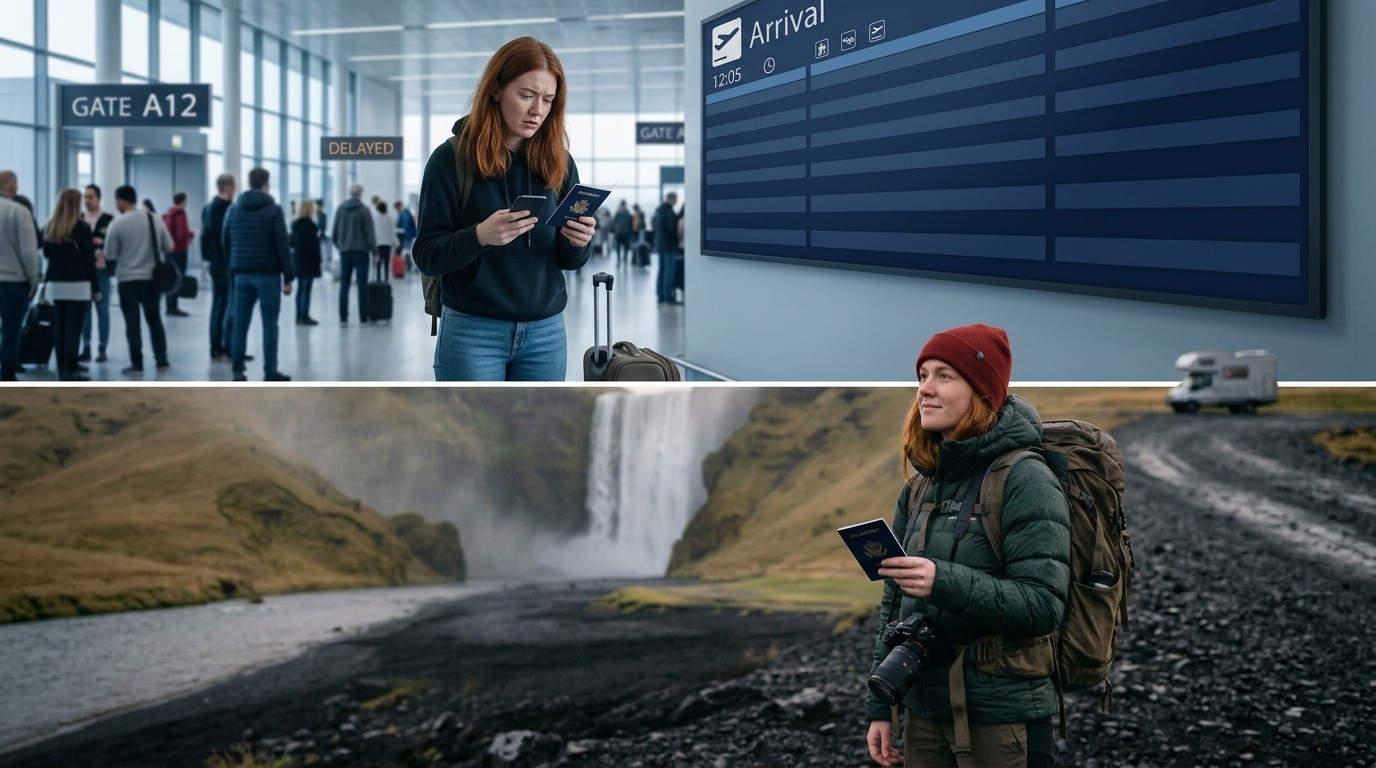
For travelers managing logistics around an Iceland trip, understanding the principles of flight risk management guide protocols matters more than many realize. Iceland-specific disruptions — volcanic ash events (historically), extreme weather, and seasonal storm activity — can affect departure schedules on short notice. The eruptions since 2021 have been effusive and have not produced ash clouds, meaning flight operations have continued normally. But the 2010 Eyjafjallajökull eruption closed European airspace for six days and stranded millions.
Building awareness of flight safety and travel risk management into your Iceland solo travel pre-departure planning is simply good practice, regardless of current volcanic activity status. This means booking refundable or flexible rate tickets where the cost difference is manageable, purchasing travel insurance that covers volcanic disruption specifically (not all policies include this), and building buffer days at the end of your itinerary rather than the beginning if your return flights are time-sensitive.
Keflavík International Airport is efficient and well-organized, but it can experience severe delays during North Atlantic winter storms. If your Iceland solo travel falls in the winter months, having accommodation flexibility in Reykjavík for an unplanned extra night is a sensible precaution that removes significant stress from the final day of any itinerary.
Most carriers operating the Iceland solo travel route — Icelandair, Norse Atlantic, and transatlantic connections — have standard weather delay policies, but volcanic disruption coverage is handled differently by different insurers. Reading the exclusions section of any travel policy before purchase is more important for Iceland than for most European destinations.
Where to Stay: Your Iceland Solo Travel Accommodation Guide
Iceland’s accommodation landscape works well for solo travelers across every budget category. Hostels in Reykjavík start around $19 per night for a dorm bed, with private rooms averaging around $137. Guesthouses offer more privacy for between $80 and $250 per night, often including breakfast. Camping costs approximately $10–$20 per person per night at sites with toilets, showers, and sometimes cooking facilities a popular option for solo travelers doing the Ring Road in summer.
Reykjavík hostel social infrastructure is genuinely useful for Iceland solo travel: common kitchens become social spaces, common areas facilitate natural conversations, and the natural grouping of people on similar Ring Road timelines means you can find hiking companions or dining partners without any effort if you want them. Solo travel in Iceland does not require solitude it just makes it easy to choose.
Outside the capital, guesthouses along the Ring Road are a highlight of Iceland solo travel. Many are family-run, the hosts are knowledgeable about local conditions, and they often provide the kind of practical advice about road closures, hidden trails, and weather windows that no app delivers as well.
The Best Things to Do on an Iceland Solo Travel Trip
The Golden Circle
The Golden Circle is the classic starting framework for South and West Iceland. Þingvellir National Park sits directly on the Mid-Atlantic Ridge — you can walk in the rift valley between two continental plates. Geysir erupts with reliable predictability every five to ten minutes. Gullfoss waterfall drops in two stages into a canyon that looks like it should not exist. All three sites are accessible in a single day from Reykjavík.
Glacier Hiking at Sólheimajökull
Small-group guided hikes operate year-round on Sólheimajökull. For Iceland solo travel, joining one is the easiest way to access an experience that would otherwise require expensive private guiding. The groups typically number six to twelve people, so you gain both safety and the casual social connection that comes from sharing an extraordinary environment with strangers.
Jökulsárlón Glacier Lagoon
One of the most photographed places in Iceland, and one of those rare locations that exceeds its photographs. Icebergs calve from Breiðamerkurjökull glacier and drift across the lagoon toward the sea, sometimes beaching on the black sand of Diamond Beach just across the road. Boat tours run on the lagoon during summer an unmissable Iceland solo travel highlight, taking you between floating ice that glows blue in afternoon light.
Snorkeling at Silfra
Between the North American and Eurasian tectonic plates, filtered glacial water fills a rift with visibility exceeding 100 meters. Snorkeling at Silfra is a guided experience that many Iceland solo travel veterans describe as the single most surreal hour of their Iceland trip. The water temperature is 2–3°C year-round, but dry suits handle that entirely.
Northern Lights (September–March)
The northern lights are one of the defining attractions of winter Iceland solo travel, requiring clear skies, solar activity, and darkness — conditions that fluctuate and cannot be guaranteed. Joining a guided northern lights tour eliminates the planning burden of finding the right location. Guides track solar activity in real time and drive to areas with clear sky windows that individual travelers cannot identify as efficiently.Lake Mývatn and North Iceland
North Iceland is where Iceland solo travel transitions from popular to genuinely exploratory. Lake Mývatn is surrounded by pseudocraters, bubbling sulfur mud pots, and lava formations that look like something from another planet. Dettifoss, fed by glacial meltwater from Vatnajökull, is the most powerful waterfall in Europe — so loud and physically forceful that you feel it before you see it.
Budget Breakdown: Real Costs of Iceland Solo Travel
Iceland solo travel has a well-earned reputation for expense, but understanding where the costs actually land lets you manage them strategically.
| Category | Budget Range (USD/day) | Money-Saving Tip |
|---|---|---|
| Accommodation | $19–$250 | Hostels, camping in summer |
| Food | $40–$100 | Cook from Bónus supermarket |
| Car Rental | $100–$300 | Book in advance, add gravel insurance |
| Activities | $50–$150 | Join group tours vs private |
| Fuel + Road Tax | $30–$60 | Plan efficient routes |
The single most effective budget strategy for Iceland solo travel is grocery shopping at Bónus — Iceland’s budget supermarket, identifiable by its distinctive cartoon pig logo. Preparing breakfast and lunch in the car or at guesthouse kitchens while eating one dinner out brings daily food costs to a manageable level. Tap water in Iceland is some of the cleanest in the world, drawn from glacial sources filtered through lava rock, so buying bottled water is entirely unnecessary — bring a reusable bottle and fill it everywhere.
Practical Tips for Iceland Solo Travel
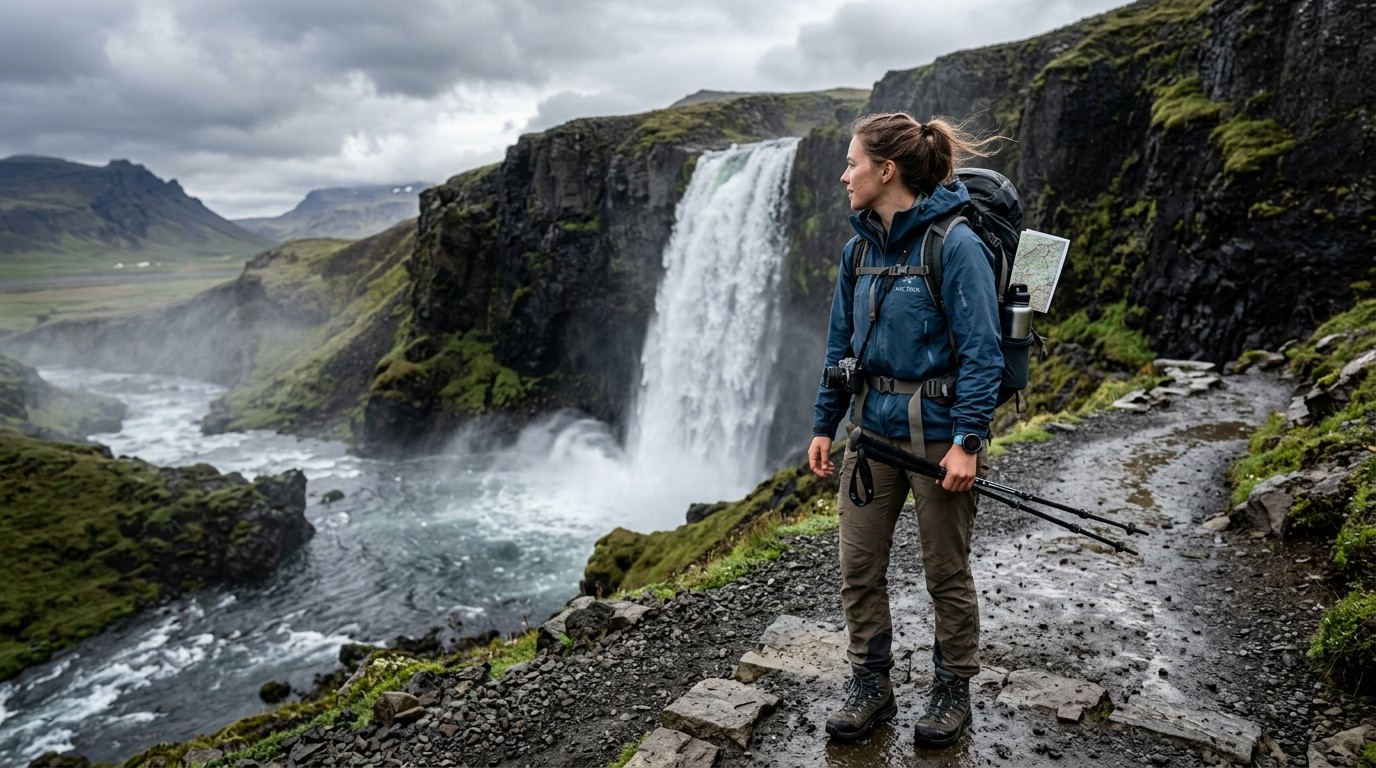
Register with SafeTravel.is before any remote driving during Iceland solo travel. This takes five minutes and means search and rescue teams have your itinerary if you fail to check in.
Off-road driving is illegal and heavily fined — a cardinal rule of Iceland solo travel. Iceland’s volcanic soil and moss ecosystems are fragile — tire tracks can take decades to recover. The fines are large enough to significantly affect your overall trip budget, and rental companies track GPS.
Follow the shower rule in geothermal pools. Showering without a swimsuit before entering any public pool is mandatory by law, consistently enforced, and matters to locals.
Do not assume your phone will have signal in the Highlands. Most of the Ring Road has strong 4G coverage, but interior routes and remote valleys drop signal entirely. Download offline maps to your phone before departing and tell someone your daily itinerary.
Winter tires are legally mandatory from November 1 to April 14. Rental cars are equipped appropriately, but confirm this at pickup and understand the additional weight and handling characteristics of a vehicle in icy conditions before you find yourself on a narrow mountain road.
Conclusion
Iceland solo travel is not a vacation in the conventional sense. It is an encounter with a landscape so geologically young and geographically extreme that it forces a kind of attention that more comfortable destinations rarely demand. The volcanoes are active. The glaciers are moving. The weather shifts in minutes. And all of this paradoxically makes Iceland one of the safest, most rewarding, and most psychologically complete destinations for Iceland solo travel. The country’s record on personal safety is unmatched. The infrastructure for independent travel is excellent. The only meaningful risks are natural ones, and every single one of them is manageable with preparation, the right information sources, and a willingness to follow local guidance. Go equipped, go curious — Iceland solo travel will do the rest.
Frequently Asked Questions (FAQ)
1. Is Iceland safe for solo travel, and is Iceland solo travel recommended in 2026?
Yes. Iceland holds the top position on the Global Peace Index and has maintained it for seventeen consecutive years. Crime is extremely rare, locals are welcoming, and the tourism infrastructure actively supports solo travelers. The primary safety concerns are natural — weather, glaciers, and volcanic activity — all of which are manageable with preparation.
2. Do I need a guide for glacier hiking in Iceland?
Yes, without exception. Walking on a glacier without a certified guide and proper crampons is dangerous regardless of your fitness level or hiking experience. Crevasses, ice bridges, and unstable surfaces are invisible from above and can be lethal. Licensed operators run glacier hikes daily at Sólheimajökull and Vatnajökull.
3. Will volcanic eruptions affect my Iceland trip?
Current volcanic activity on the Reykjanes Peninsula is highly localized and does not affect Reykjavík, South Coast attractions, or flight operations. Check SafeTravel.is daily, purchase travel insurance that covers volcanic disruption, and avoid any areas under official exclusion orders.
4. What is the best time of year for Iceland solo travel?
Summer (June–August) is best for first-timers — good roads, long daylight, and full activity availability. Autumn (September–October) offers northern lights and fewer crowds. Winter gives you ice caves and the best aurora conditions but requires confident driving experience on icy roads.
5. How much does Iceland solo travel cost per day?
Budget travelers can manage on $80–$120 per day by camping, cooking from supermarkets, and joining group tours. A mid-range solo trip spending on guesthouses, occasional restaurants, and multiple activities typically runs $200–$350 per day. Accommodation and car rental are the largest cost drivers.
6. Do I need an international driver’s license in Iceland?
No. A standard driver’s license from most countries — including the US, UK, EU nations, Australia, and Canada — is accepted for car rental in Iceland. Confirm your specific country’s license is accepted with your rental company before booking.
7. What is SafeTravel.is and why does it matter?
SafeTravel.is is Iceland’s official travel safety portal operated by the Icelandic Association for Search and Rescue (ICE-SAR). You can register your travel plans there so that rescue teams have your itinerary in case you fail to check in. It also provides real-time alerts for volcanic activity, weather, and road closures.
8. Is solo female travel in Iceland safe?
Yes — Iceland is consistently ranked among the top destinations in the world for solo female travelers. Street harassment is rare, the country tops the WEF Global Gender Gap Report for the sixteenth consecutive year, and women report feeling comfortable traveling and being out alone at night in Reykjavík and across the country.
9. Can Iceland solo travel include the full Ring Road in 7 days?
Yes, though it requires full days and accepting that some stops will be brief. Seven days is enough to drive the full 1,332-kilometer route and see major highlights. Ten days or more allows a more relaxed pace and opens up detours to the Westfjords, Snæfellsnes Peninsula, and deeper into North Iceland.
10. What travel insurance do I need for Iceland solo travel?
Purchase travel insurance that specifically covers helicopter rescue, medical evacuation, and volcanic disruption. Standard travel policies often exclude volcanic events — read the exclusions section carefully before purchasing. Glacier and highland activities may also require specific adventure sports coverage depending on your policy.



Comments (1)
Solo Travel Portugal : Ultimate Itinerary And Tipssays:
August 27, 2026 at 9:21 pm[…] who enjoyed Iceland Solo Travel often appreciate Portugal for the opposite reasons: warmer weather, busier streets, and a broader […]